
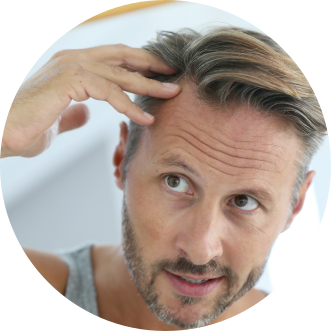
Male Hair Loss
Hair loss in men is common and affects most men at some point in their lifetime. The most common cause is male pattern baldness, but stress, genetics, hormonal changes, and medical conditions can also contribute.
At Argyle Hair Solutions, we specialize in personalized men’s hair restoration treatments, including non-surgical hair replacement and custom hair systems designed to restore natural-looking hair and confidence.
So, you think you are losing your hair. Is there any good news?

Approximately 95% of male hair loss is caused by Androgenetic Alopecia, also known as male pattern baldness. This hereditary condition affects how hair follicles respond to hormones and leads to gradual thinning, especially at the temples and crown.
The good news is that male pattern baldness is relatively straightforward to diagnose. When identified early, proactive treatment can significantly slow hair loss, preserve existing hair, and improve overall hair density.
What is Androgenetic Alopecia?
Male Androgenetic Alopecia (MAA), also known as male pattern baldness (MPB), is a genetic condition caused by sensitivity to dihydrotestosterone (DHT), a hormone derived from testosterone. This sensitivity causes hair follicles to gradually shrink, leading to thinner, shorter hair over time.
MAA affects approximately 30–50% of men by age 50, although it can begin as early as the teenage years.
What kind of tests do I need?
Diagnosing male hair loss is typically straightforward. It usually begins with a consultation and health questionnaire to identify medical history, lifestyle factors, stress levels, and family history that may contribute to hair thinning.
A trichoscopy — a close examination of the scalp using magnification — is often performed to evaluate hair density, follicle health, and patterns consistent with male pattern baldness.
Is my hair loss permanent or will it grow back?
Hair restoration outcomes vary based on:
-
The stage of hair loss
-
How long follicles have been miniaturizing
-
Overall scalp health
-
The treatment approach used
There are multiple treatment options available, including single therapies or combination (multi-therapeutic) programs designed to slow hair loss and improve density.
However, once a hair follicle has miniaturized beyond a certain point, it cannot be revived. This is why early intervention is critical for achieving the best possible results.
How can I know how bad my hair loss is?
Certain indicators like age and family history can help your hair restoration professional make an educated guess. Again, this is why it is so imperative that a treatment program be started as early as possible.
Should I change my hair care products?
What are some treatment options for hair loss?
- A topical minoxidil program is one of the more common treatment options used by men with MAA. It’s a once daily topical scalp treatment aimed at stopping and reversing hair loss.
- Low-level-laser-therapy (LLLT) is another method used by men and women to stimulate hair growth. Used by the medical industry for years to aid in tissue repair, LLLT has shown remarkable effects for hair growth via the same mechanisms that support the healing of joints and tissue.
- Micro needling and PRP have gain a lot of recognition in recent years. Though there is not a conclusive study stating that one is superior to the other, there is strong evidence for the stimulatory effects of harnessing your own immune response to repair hair follicles.
- Hair transplants are the most invasive way of treating hair loss, but also one of the most immediate. Cost prohibitive for some, hair transplants are a popular go to for men who want results immediately. Make sure to discuss the long-term outlook for transplants before jumping into a treatment. Some forms of transplants can cause scarring that will show later in life as the hair thins. Not even transplants last forever.
- Non-surgical Hair Restoration is the most immediate, and in some cases the only, option available. NSHR offers men and women who are not candidates for conventional treatment the option of having a full head of hair within weeks or even days. NSHR has some of the highest customer approval ratings of any form of hair restoration program and can be maintained indefinitely.
What are other conditions that cause hair loss?
Although most of the hair loss in men is androgenetic alopecia, there are other conditions that can lead to hair loss or have an amplifying effect.
Telogen Effluvium is the second most common cause of hair loss in men. Telogen effluvium is a condition that forces a larger than normal amount of hair to enter the resting and shedding phase of the growth cycle prematurely. A person with this condition may lose up to 4 times the normal amount of hair daily, though hair loss is usually diffuse (all over the scalp). Telogen effluvium is generally a temporary condition brought on by severe psychological stress or physiological change. Causes include but are not limited to:
- Severe stress (divorce or death of a family member)
- Surgery
- Rapid weight loss
- Thyroid problems
- Certain medications
Though less common, there are other hair loss conditions that can have a severe and sometimes permanent impact on hair follicles and scalp health.
- Alopecia Areata
- Trichotillomania
- Alopecia Totalis
- Alopecia Universalis
- Cicatrical Alopecia (Scarring Alopecia)
- Frontal Fibrosing Alopecia
If your hair loss is atypical of the patterns laid out in the Norwood Scale you may be experiencing something other than conventional MAA. Talk to a hair loss specialist to lean more

Female Hair Loss
Female hair loss is common and can be caused by genetics, hormonal changes, stress, medical conditions, or aging. Unlike male pattern baldness, women often experience overall thinning rather than complete bald spots.
At Argyle Hair Solutions, we provide personalized, non-surgical hair restoration solutions for women designed to restore natural volume, coverage, and confidence.
So, you think you are losing your hair. Is there any good news?
Female hair loss is often caused by hormonal imbalances or micronutrient deficiencies that disrupt the natural hair growth cycle. When this cycle is interrupted, hair may thin, shed excessively, or become more prone to breakage.
In many cases, female hair loss has multiple contributing factors. These can include stress, thyroid disorders, pregnancy, menopause, nutritional deficiencies, or underlying medical conditions.
What is the main reason for female hair loss?
As many as 50% of women under 30 and 60% of women over 70 are affected by this condition, which left untreated, will result in the progressive decline of scalp hair.
Female androgenetic alopecia, just as the name implies, is a polygenetic condition characterized by a sensitivity to certain androgens. Female Androgenetic Alopecia (FAA) can have several underlying factors that magnify the aggressiveness of the condition.
Because of this, lab testing may be needed to discover the root causes of the condition, and a multitherapeutic approach is often needed to treat correctly.
Genetic female hair loss differs from men in the pattern of thinning. Where men thin in a discernable pattern progressing from the hair line or crown, FAA thinning tends to happen in a diffuse pattern over the entire scalp. Because you can lose as much as 50% of your scalp hair before it becomes noticeable, women with FAA often discover their thinning hair after it has already undergone significant decline.
What are some of the underlying factors that cause or aggravate hair loss?
As stated at the outset, female hair loss is a complicated issue with genetic, hormonal, dietary, and environmental factors potentially all playing a part. In addition, there are behavioral and autoimmune disorders that can have a damaging and permanent impact on your hair’s growth and appearance.
With all of these forces at play, understanding the root cause of your hair loss can be a daunting task. Let us take a quick look at some of these considerations and a few of the underlying causes.
Hormonal
- Thyroid imbalance
- Polycystic ovarian syndrome (PCOS)
- High testosterone
These are just a few of the hormonal factors that can impact hair loss.
With hormone associated hair loss it is important to work with your hair loss practitioner in conjunction with your doctor to understand treatment options and effectiveness.
Dietary
- Mineral deficiency
- Inflammatory foods
- Protein deficiency
These are common causes for female hair loss related to diet. Understanding the components of a well-rounded diet and how it improves hair production and density can be a simple way of enhancing your self-image through lifestyle maintenance.
Diet is the one factor involved in hair loss over which we have total control.
Environmental
- Heavy metal toxicity from contaminated food or water
- Damaging chemicals from salon treatments
- Certain medications
All of these and more can play a large role in hair loss. In some of these cases hair loss can be a precursor to larger health issues. The damaging effect of chemical related toxicity can have far reaching consequences and do lasting harm to not only hair, but vital organs and maintenance systems that regulate core body functions.
Behavioral and Autoimmune
Behavioral disorders like trichotillomania (an impulse to pull hair out by the root) or autoimmune disorders like alopecia areata, while rare, can have a shattering impact on self-image. Understanding these conditions is the first step in learning how to manage them.
My hair is thinning, what should I do?
Hair can shed in excess amounts for a variety of reasons and at any age. A hair restoration practitioner can help you identify and understand the potential trigger and treatment to aid in regrowth. Sometimes the right course of action is to do nothing at all.
Are my hair care products causing my thinning hair?
People with thinning hair should be aware of the best products and practices to maintain maximum quality as this can help mask hair that is thinning for other reasons.
Should I take vitamins for my hair loss?
In general, vitamins do not promote healthier hair growth unless you are deficient in that particular vitamin. And even then, supplementation may not be enough if you are experiencing absorption issues from a medical condition or medication.
Herbs are another commodity feeding the machine, but not all are bogus.
Herbs like saw palmetto and sariva have been used to strengthen hair can combat hair loss for generations. Using them can be a major part of any hair restoration treatment program when used correctly.
Are my medications affecting my hair loss?
Some of these things impact the quality of your hair, affecting the structure of the hair shaft itself. This can lead to dull porous hair that is prone to breakage. More severe effects can impact the hair follicle itself leading to an overall decline in hair quantity.